Product Launch: Personalized Campaign Messages
Wallet notifications can now carry each member’s own details. Members expect personalized communication everywhere else, and this takes no additional integration to turn on.
Personalized Campaign Messages Are Here.
Partners building on the Badge API have been able to personalize push notifications for a while. What is new is that it no longer takes a developer. Personalization now lives in the campaign editor, so the person writing the campaign is the person who sets it up.
Personalized messaging has been one of the most requested capabilities on our list. Loyalty teams, platforms, and gift card operators have all asked for the same thing in different words, and it is live today.
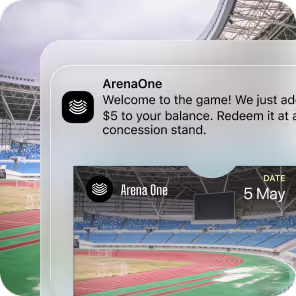
Campaign push notifications can now carry values from the pass and the member record. Points, tier, name, reward, whatever your program already tracks. One campaign, resolved for each recipient at the moment their notification is created.
Members already expect this everywhere else
Personalized communication stopped being a differentiator some time ago. It became the baseline, and members carry that expectation from one channel into the next.
McKinsey put a number on the consumer side of it: 78 percent of consumers said personalized communications made them more likely to repurchase.
Source: McKinsey’s Next in Personalization 2021 Report, published November 2021
That research covers marketing communications broadly. We have no measured data yet on what personalization does in wallet specifically, and we would rather say so than borrow someone else's number.
What we believe, and what we are building toward, is this. A wallet notification is the most direct line a program has to a member. It shows up when it is useful, in context, and it is native to the phone’s operating system rather than one more app to open. Every other channel has to pull the member somewhere else first.
No additional integration required
Personalization draws on the Custom Attributes your program already uses. If a value renders on your pass today, it can now go into a campaign message.
That means no new endpoints, no schema changes, and no engineering ticket to open. Programs already keeping attributes current through the API get that freshness in their notifications automatically, because the message reads the same member record the pass does.
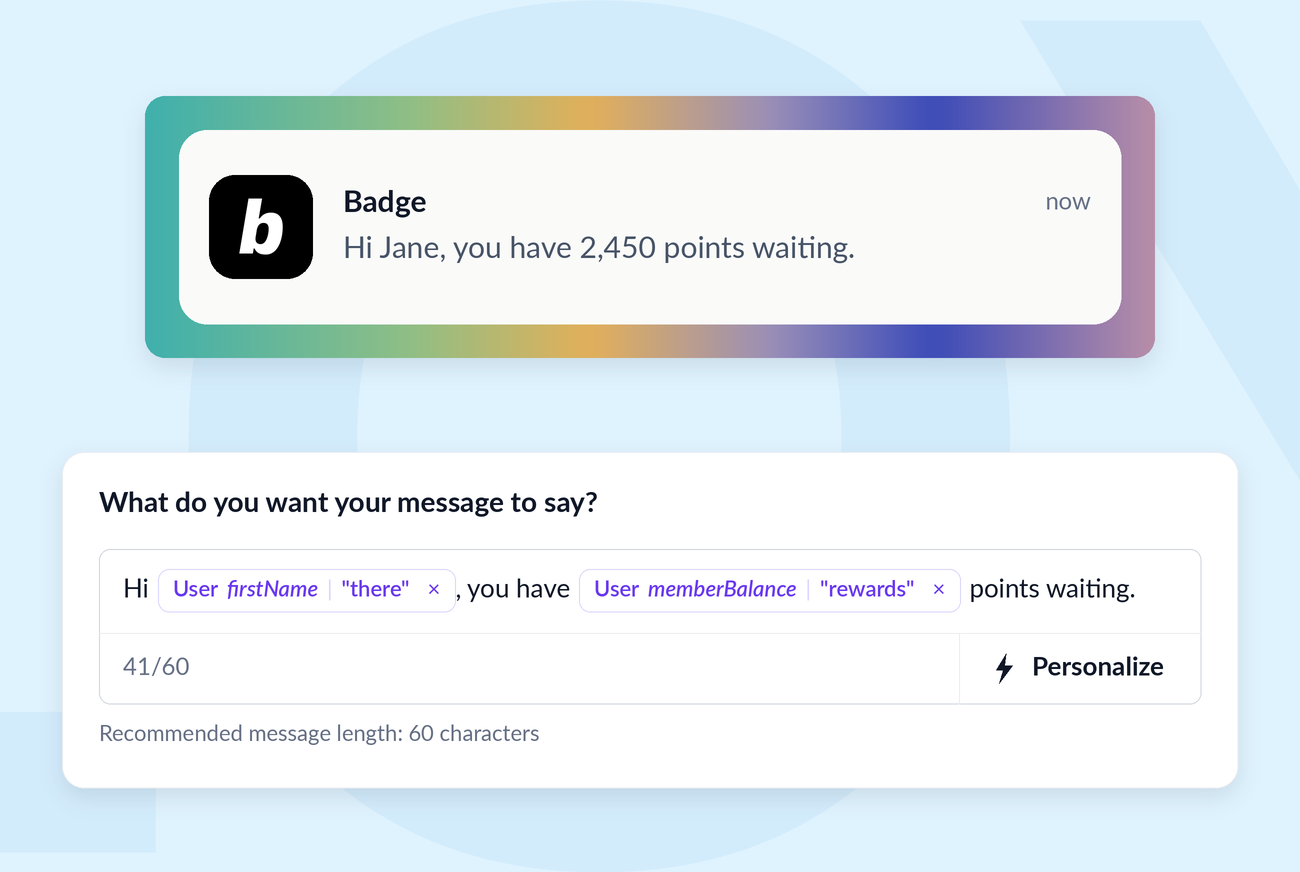
Setup happens in the campaign editor. Click ⚡ Personalize next to the message field, choose an attribute, set a default, and it drops into the message as a chip. That is the whole configuration.

A marketing team can turn this on themselves, without waiting for engineering time.
Every value carries a fallback
Unfortunately, member data is never uniformly complete. Some people joined in store and gave a phone number. Some arrived through a partner feed with an ID and little else. Some have been in the program nine years and have everything on file.
So every personalized value you include carries a default, used when a member has no value for it. The campaign will not save without one.
Write the message once:
Hi First-Name, you have Points-Balance points waiting.
It arrives as:
- Full data: Hi Jane, you have 2,450 points waiting.
- No data: Hi there, you have rewards points waiting.
Two complete messages. Neither looks broken, and the member you know gets a personalized one.
Personalize Campaign Messages in the Help Center covers setting defaults and previewing before you send.
Operating at scale
One message that reads correctly for everyone is one message you can send to everyone.
That means fewer segments to build and maintain, because you are no longer splitting your base by how complete its data is. It means less copy to write and reconcile, because one message now covers what used to take three.
For a team running wallet alongside every other channel, that is the difference between a campaign that goes out this week and one that waits for someone to find the time.
Talk to us about building wallet campaigns that read like they were written for them.
Source: Nidhi Arora, Daniel Ensslen, Lars Fiedler, Wei Wei Liu, Kelsey Robinson, Eli Stein and Gustavo Schüler, “The value of getting personalization right or wrong is multiplying,” McKinsey & Company, November 12, 2021 (Next in Personalization 2021 Report).