Walmart Tap to Pay
The largest U.S. retailer just validated mobile Wallet for payments. The bigger opportunity for retailers is turning that same surface on for loyalty.
Walmart Adds Tap to Pay, and Wallet Stops Being Optional
The largest U.S. retailer just validated mobile Wallet for payments. The bigger opportunity for retailers is turning that same surface on for loyalty.
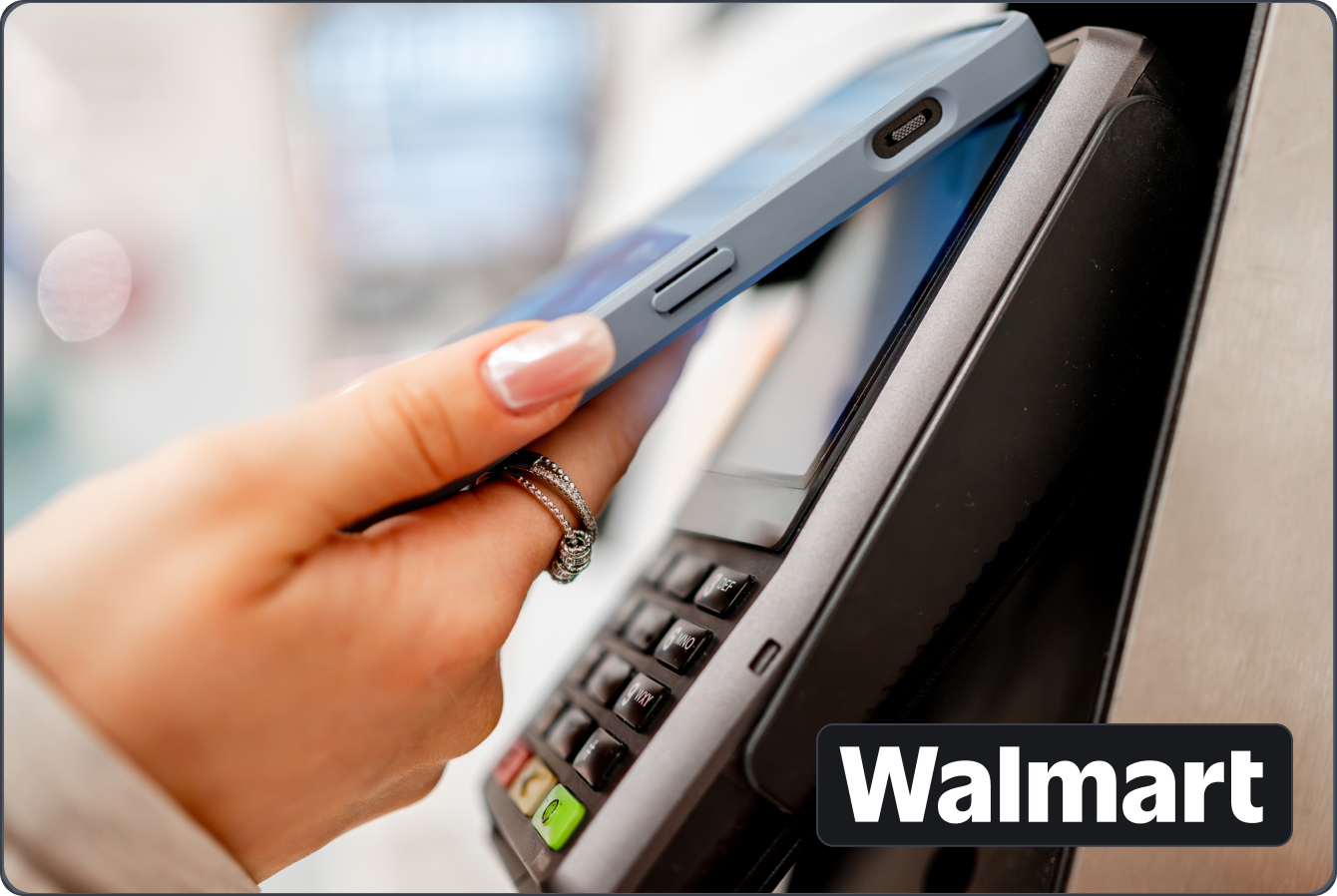
On August 21, Walmart announced that Tap to Pay is coming to Walmart and Sam’s Club. The rollout began Monday, August 24 at select stores and clubs, reaches all U.S. stores and clubs by the end of 2026, and extends to fuel stations by mid-2027.
If you work in payments or loyalty, that announcement is bigger than it reads.
Walmart is the largest retailer in the United States. NRF ranks it No. 1 by U.S. retail sales, at roughly $576 billion in 2025, nearly twice Amazon at No. 2.
And for years, Walmart was also one of the most notable holdouts from the mobile wallet shift.
That makes this more than another retailer adding contactless payments.
It is a validation point for Wallet itself.
The holdout is no longer holding out
For years, Walmart pointed customers toward its own app rather than the Wallet already built into their phone.
Walmart Pay remains part of that strategy. It lives inside the Walmart app and lets customers pay, view purchases and receipts, and access Walmart+ fuel savings. At Sam’s Club, Scan & Go similarly keeps payment within Walmart’s own experience.
Tap to Pay changes the posture.
Customers can now check out using an eligible contactless card, phone or smartwatch. Walmart is adding that option alongside cash, credit cards, Walmart Pay and Scan & Go rather than requiring customers to use a Walmart-controlled payment experience.
There is an even more interesting detail buried in the announcement: Walmart says customers will also be able to add eligible Walmart, Sam’s Club and OnePay cards to their digital wallets.
Walmart is not just accepting Wallet at the register.
It is putting more of its own brand experience inside Wallet.
For the retailer with perhaps the most leverage to resist the Wallet shift, that is a meaningful signal.
Customers already made the decision
New PYMNTS Intelligence data helps explain why Walmart is moving now.
Payment acceptance influences where 65% of U.S. shoppers choose to buy, up from 58% in January 2023. That sensitivity is identical among higher- and lower-income shoppers.
Customers are increasingly checking before they ever reach the register. Among shoppers using mobile devices in stores, 16% looked up which payment methods a retailer accepted in March 2026, up from 11% in 2024, a 45% increase.
Payment choice is no longer just a checkout detail.
It can influence where a customer chooses to shop.
That makes Walmart’s announcement the supply side catching up to customer behavior that has already been building on the demand side.
But payment acceptance is only the first part of the opportunity.
Payments get customers into Wallet. Loyalty is the unlock.
For most customers, payment is the behavior that makes mobile Wallet familiar.
Tap your phone. Pay. Keep moving.
As that behavior becomes commonplace, Apple Wallet, Google Wallet and Samsung Wallet become familiar surfaces in the customer journey.
For retailers, accepting that payment is increasingly the floor.
The more strategic question is:
What should your brand do inside Wallet once your customers are already there?
Loyalty is one of the most natural answers.
A payment credential completes a transaction.
A loyalty credential connects that transaction to the broader customer journey.
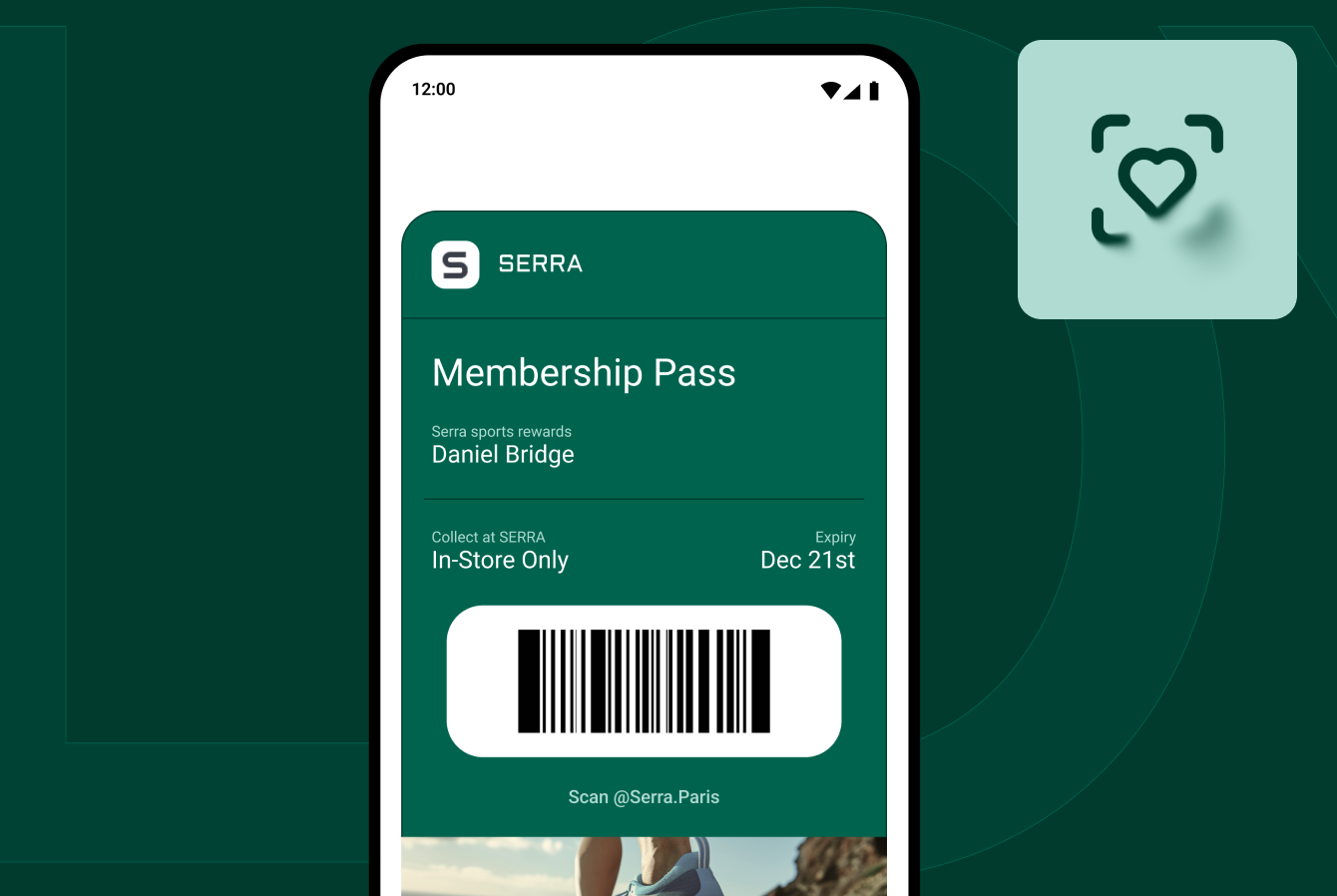
It can identify the member, show their tier, surface current points or rewards, reflect new benefits and stay current as their journey with the brand changes.
And it can live in the same place the customer increasingly reaches for when it is time to pay.
That is a much bigger opportunity than replacing a card swipe with a tap.
The secret sauce is connecting payment to loyalty
Think about the typical loyalty experience at checkout today.
A customer identifies themselves with a phone number, barcode or app. Then they pay with a separate card or device. Later, they may open another app or email to find their points, rewards or benefits.
Payment, identity and loyalty are often treated as separate parts of the journey because the underlying systems were built separately.
Mobile Wallet creates an opportunity to bring them much closer together.
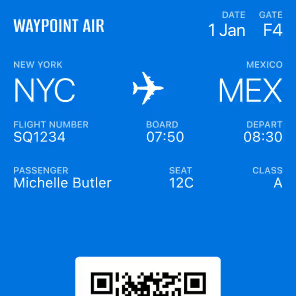
The same Wallet can hold the credential used to pay and the loyalty or membership credential used to identify the customer.
A loyalty pass can stay current with the customer’s status, rewards and benefits. It can be immediately accessible without asking the customer to download a new app or search for an account. And increasingly, Wallet can help connect identification, loyalty and payment at the physical point of sale.
That is the real unlock.
Payments create the habit of using Wallet. Loyalty turns Wallet into a persistent part of the customer journey.
Acceptance is the floor, not the ceiling
Most retailers will look at Walmart’s announcement and see a payments story.
And at one level, it is.
Walmart is enabling a payment experience customers increasingly expect. Other retailers will do the same. Over time, accepting a tap becomes parity.
But parity at checkout is not where the long-term advantage sits.
The opportunity is in what else the retailer can make useful inside Wallet.
A loyalty program already contains most of the ingredients: customer identity, membership, status, points, rewards, benefits and a reason to return.
Wallet gives retailers a native surface for bringing those parts of the loyalty journey closer to the customer without replacing the systems they have already built.
The loyalty platform remains the system of record. The CRM remains the customer data layer. The app can still provide a deeper branded experience.
Wallet becomes the surface that makes the loyalty journey immediately accessible.
That is the shift retailers should be paying attention to.
Walmart validated the first chapter
We recently wrote about digital wallets closing in on cash at checkout, with wallet share reaching 11.8% of customers’ most recent in-store purchases against 12.1% for cash.
Now the largest U.S. retailer is responding.
Walmart spent years building an alternative to the payment experiences inside customers’ phones. Today, it is opening its entire U.S. footprint to Tap to Pay and putting its own eligible payment credentials into digital wallets.
That is validation at a scale that is difficult to ignore.
But payments are only the beginning.
For retailers, the bigger opportunity is what happens when loyalty moves into Wallet too.
Pay. Be recognized. See your status and rewards. Use your benefits.
Instead of treating each as a separate step, Wallet gives retailers the infrastructure to bring more of the customer journey together on a surface customers already use.
At Badge, that is the future we are building toward: infrastructure for brands to issue and operate dynamic loyalty and membership experiences across Apple Wallet, Google Wallet and Samsung Wallet.
Walmart just gave the market another reason to believe Wallet is becoming essential.
Payments are the entry point. Loyalty is where it gets interesting.
Sources: Walmart, “More Ways to Pay: Tap to Pay Is Coming to Walmart and Sam’s Club,” August 21, 2026. PYMNTS Intelligence and Visa Acceptance Solutions, “Global Digital Shopping Index: U.S. Playbook, The New American Shopper,” as reported by PYMNTS on August 24, 2026. National Retail Federation, 2026 Top 100 Retailers.
If your loyalty program is ready to move beyond the app and into the Wallet your customers already use, Badge provides the infrastructure to make it happen.